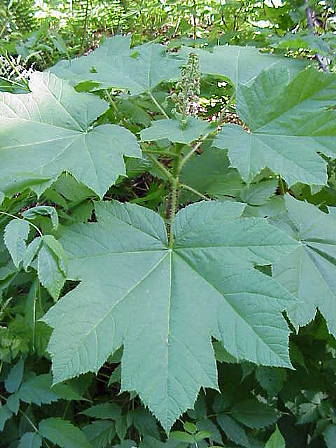
Devil’s club. An intimidating name befitting this plant. Oplopanax Horridus is it’s scientific name. It’s also known as Alaskan Ginseng, and while the genus Oplopanax is in the same family, Araliaceae, its not a true ginseng and the Oplopanax genus is chemically diverse from Panax. It has been used extensively by indigenous tribes for generations as healing medicine for a large variety of ailments, and indeed has become known as Tlingit aspirin. More recently, there have been several informative studies done on the chemical and pharmacological impacts of devil’s club.
Devil’s club grows in the rain forests of the Pacific Northwest, as well as a disjunct on some islands in Lake Superior. It has large woody stems covered in very nasty sharp spines. Each stem will generally have several large palmate leaves that also carry sharp spines along it’s stems and leaf veins. The spines can detach and become embedded in your skin causing festering wounds. Try to avoid the spines. It grows best near water and generally gets to be about 2 meters tall. Some plants, however, can shoot up to over 5 meters tall of they’re undisturbed and have the right conditions.
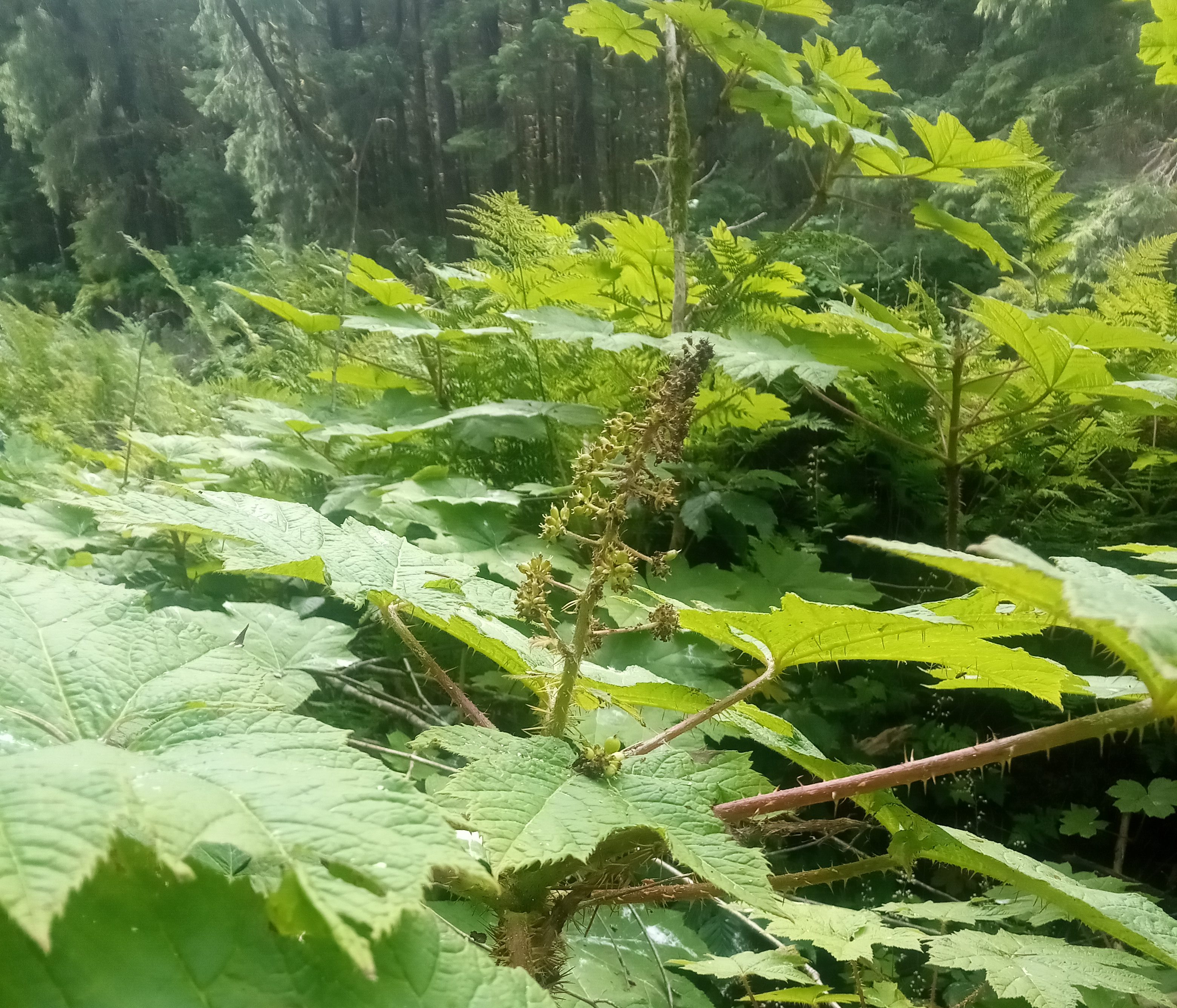
The Devil’s Club inflorescence is a dense cone of flowers at the top of the stems. When pollinated, each flower develops into a small, inedible bright red drupe. The plant takes a long time to reach seed-bearing maturity, so it can persist through layering and rhizomatic clonal colonies, either through the roots or through the stems that bend over enough to touch the earth.
“Hunters were in the mountains hunting bears. A hunter threw his spear and wounded a bear. The bear ran off. The lead hunter told the hunters they needed to find the bear. They tracked the bear by following the trail of blood left in the woods. The hunters could see the bear around some devil’s club. They stopped to watch it. They saw the bear use its paw to scrape off the thorns, and teeth to peel the cambium layer (the medicine) from the stalk. The bear chewed the cambium layer and placed it on his wound. The bear taught us that the devil’s club is powerful medicine.”
As told by Daanawáaḵ, Lukaax̱.ádi Lḵoot Ḵwáan at Lḵoot Culture Camp.
From the book Haa ḵusteeyí tlél aax̱ yoo uhéik: Our Way of Life Never Disappears. Sealaska Heritage Institute 2021
There are many different ways to use devil’s club. Known as s’áxt’ by the Tlingit, they would use the roots and inner bark as a chew, poultice, tonic, tea, bath, or ointment depending on the ailment. In a bath, for example, devil’s club is said to reduce the pain from rheumatoid arthritis. Taken internally as a tea or tonic, and it will help heal coughs, colds, ulcers, and even tuberculosis1. Other studies have discovered anticancer properties in several novel compounds found in devil’s club2. Different parts of this plant are used by over 38 linguistic groups for over 34 categories of physical ailments3.
It wasn’t just medicine. It’s branches hung over a doorway wards off evil spirits. Charms, earrings, and pendants are carved from the wood. The charcoal is used to create ceremonial face paints, tattoos, and natural deodorant. Devil’s club wood is exceptionally strong for how lightweight it is, and has been used to carve fishing lures and hooks.
I’ll be using it to make salve for The Project. I use the inner bark of devil’s club, responsibly harvested locally, prepared in extra virgin olive oil, combined with beeswax, and poured into tins. It’s simple, honest medicine that will relieve sore muscles and joint aches, alleviate skin irritations, soothe arthritis, and protect against bacteria and infection.
Gunalchéesh, Háw’aa, and Thank you!
- Calway T, Du GJ, Wang CZ, Huang WH, Zhao J, Li SP, Yuan CS. Chemical and pharmacological studies of Oplopanax horridus, a North American botanical. J Nat Med. 2012 Apr;66(2):249-56. doi: 10.1007/s11418-011-0602-2. Epub 2011 Nov 20. PMID: 22101399; PMCID: PMC3345165. ↩︎
- Wu K, Wang CZ, Yuan CS, Huang WH. Oplopanax horridus: Phytochemistry and Pharmacological Diversity and Structure-Activity Relationship on Anticancer Effects. Evid Based Complement Alternat Med. 2018 Sep 13;2018:9186926. doi: 10.1155/2018/9186926. PMID: 30302120; PMCID: PMC6158975. ↩︎
- Trevor C. Lantz, Kristina Swerhun, Nancy J. Turner. Devil’s Club (Oplopanax horridus): An Ethnobotanical Review. ISSUE: 62 Page: 33-48 American Botanist Society Herbalgram
 The Grateful Healing Project
Leave a comment